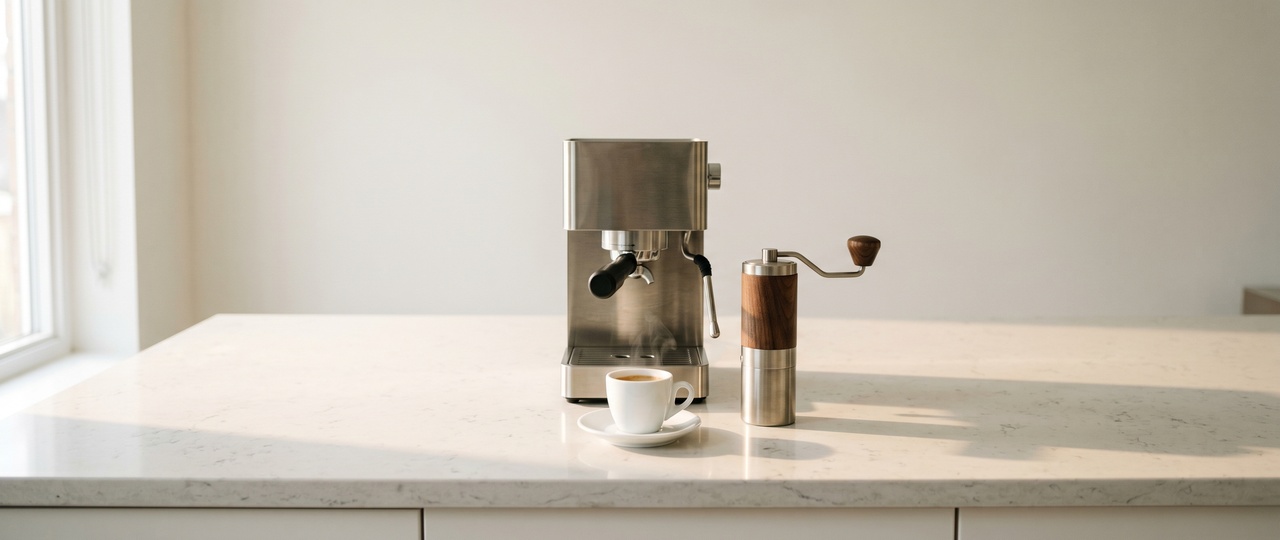
The morning is where most of my best thinking happens. Markets open at 2:30pm UK time on NQ futures — which means my mornings are genuinely mine. No pressure, no positions on, no reason to rush. Coffee is part of that. It's not a performance ritual. It's not a production. But it is deliberate, and the kit on the counter reflects that.
I'm going to tell you exactly what I use, roughly what I paid, and whether I'd buy it again. I update this article when something changes on the counter — so what you're reading reflects the current setup, not a wishlist.
"The morning is the best part of a trading day. Markets open at 2:30pm. What happens before that — coffee, clarity, no noise — is what makes the rest of the day possible."
The Machine — Sage Bambino Plus
I've had the Sage Bambino Plus for about two years. It replaced a De'Longhi that produced decent coffee but required too much patience — the warm-up time, the inconsistent steam pressure, the general faff. The Bambino is faster, more consistent, and produces better microfoam for the flat white that starts every morning.
What sold me was the three-second heat-up and the auto-purge after steaming. Both are small things that make daily use far more pleasant. The machine knows what it's doing — pre-infusion is built in, the pressure is regulated, and the results are consistent once you've got your grind dialled. I'm not changing it. It's the right machine for my routine.
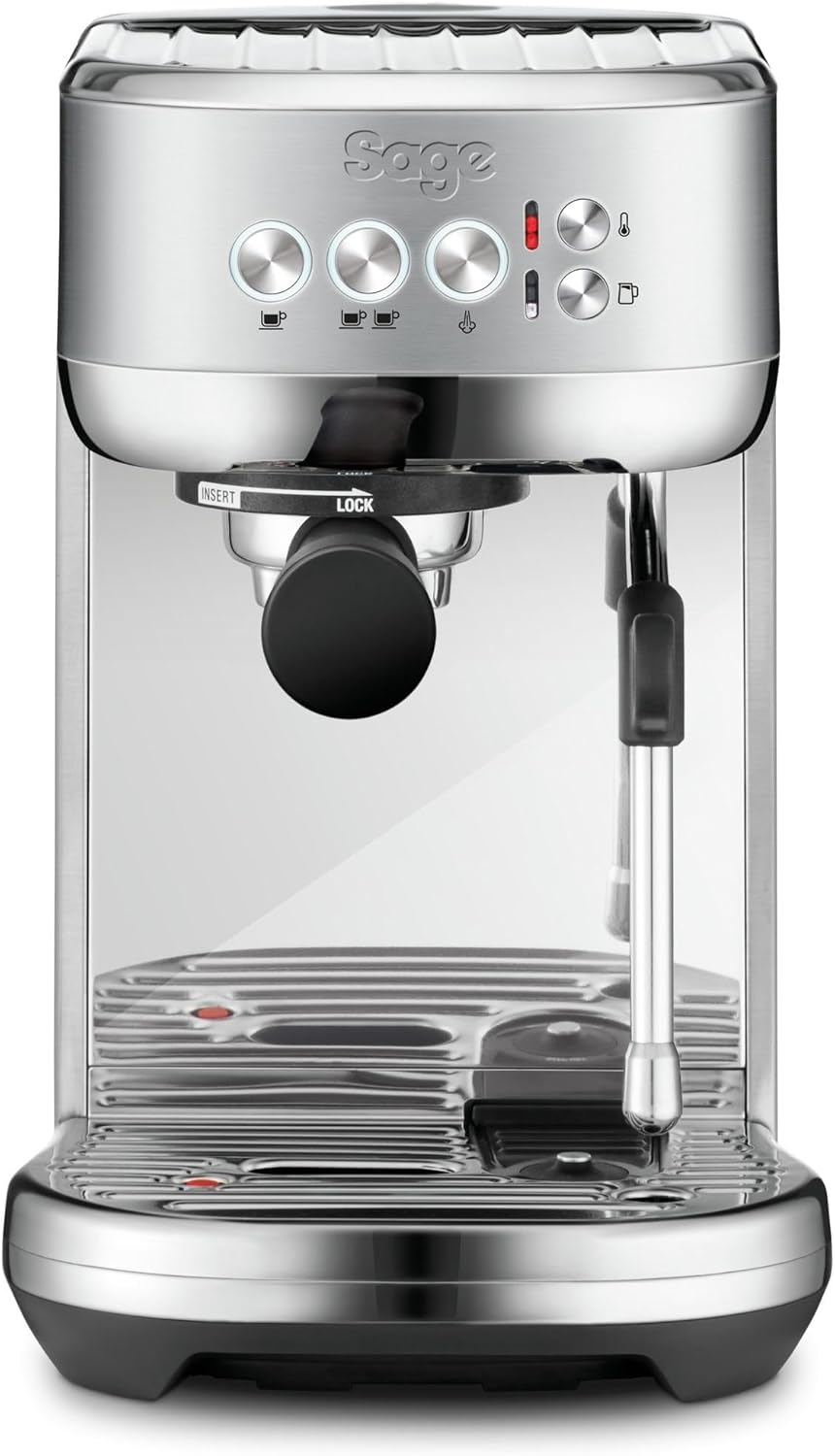
My everyday machine. Three-second heat-up, built-in pre-infusion, excellent auto-purge steam wand, and a compact footprint that earns its counter space. Paired with a quality grinder it produces results that genuinely surprise people. I've recommended it to three people — all still using theirs.
Pros
- 3-second heat-up
- Built-in pre-infusion
- Auto steam purge
- Compact footprint
Cons
- 54mm portafilter
- No PID temperature display
The Grinder — 1Zpresso J-Ultra
This surprises people. A manual grinder paired with an espresso machine sounds like a masochistic choice. The reality is that 45 seconds of grinding is part of the morning, not a disruption to it. And the grind quality from the J-Ultra at espresso fineness is better than electric grinders costing £150–200 — which was the alternative I was comparing it against.
I use the external adjustment ring to move between espresso (my default) and the occasional V60 at weekends without any drama. The retention is negligible — I get almost all the coffee into the portafilter. I've tried two electric grinders in this price bracket and returned both. The J-Ultra stays.
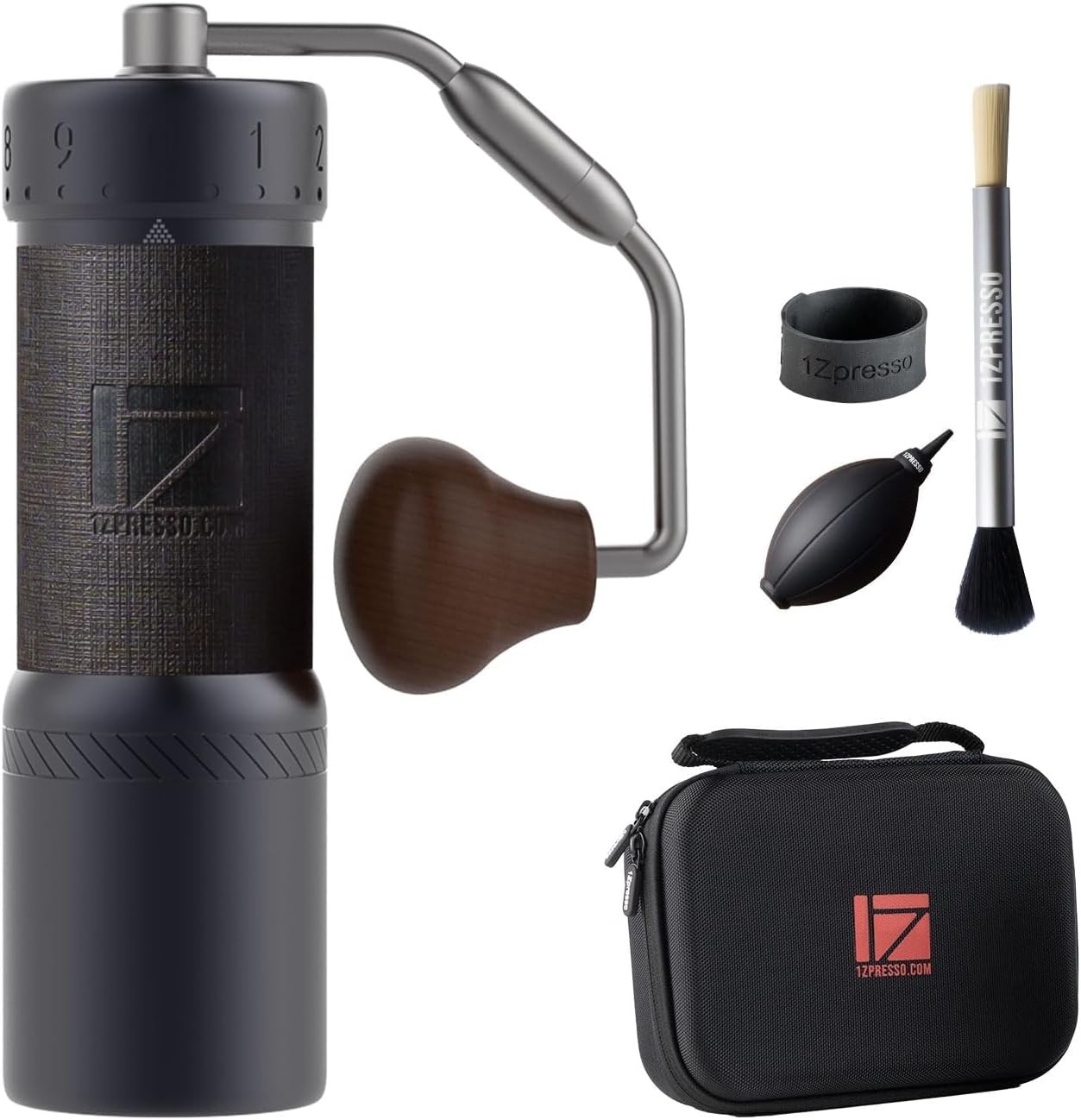
Upgraded from the J-Ultra to the J-Ultra — the step up in burr quality is immediately noticeable at espresso fineness. External adjustment ring, minimal retention, and grind consistency that embarrasses electric grinders at twice the price. About 40 seconds per dose. Every time I've questioned whether to switch electric, I've come back to this.
Pros
- Exceptional grind consistency
- External adjustment ring
- Near-zero retention
- Espresso to filter versatile
Cons
- Manual effort required
- Premium price for hand grinder
The Kettle — Fellow Stagg EKG (for Pour-Over Weekends)
The Stagg EKG doesn't get daily use — the Bambino doesn't need a gooseneck kettle for espresso, and I'm not precious about the temperature of water for a morning flat white. But at weekends when I'm making a V60 and actually paying attention, the Stagg matters. Precise temperature to the degree, the gooseneck spout gives you total control over flow rate, and it's the most beautiful piece of kitchen kit I own.
If you don't make filter coffee, you don't need it. If you do, you'll understand immediately why the standard kettle I used before it was a limitation. Available on Amazon UK.
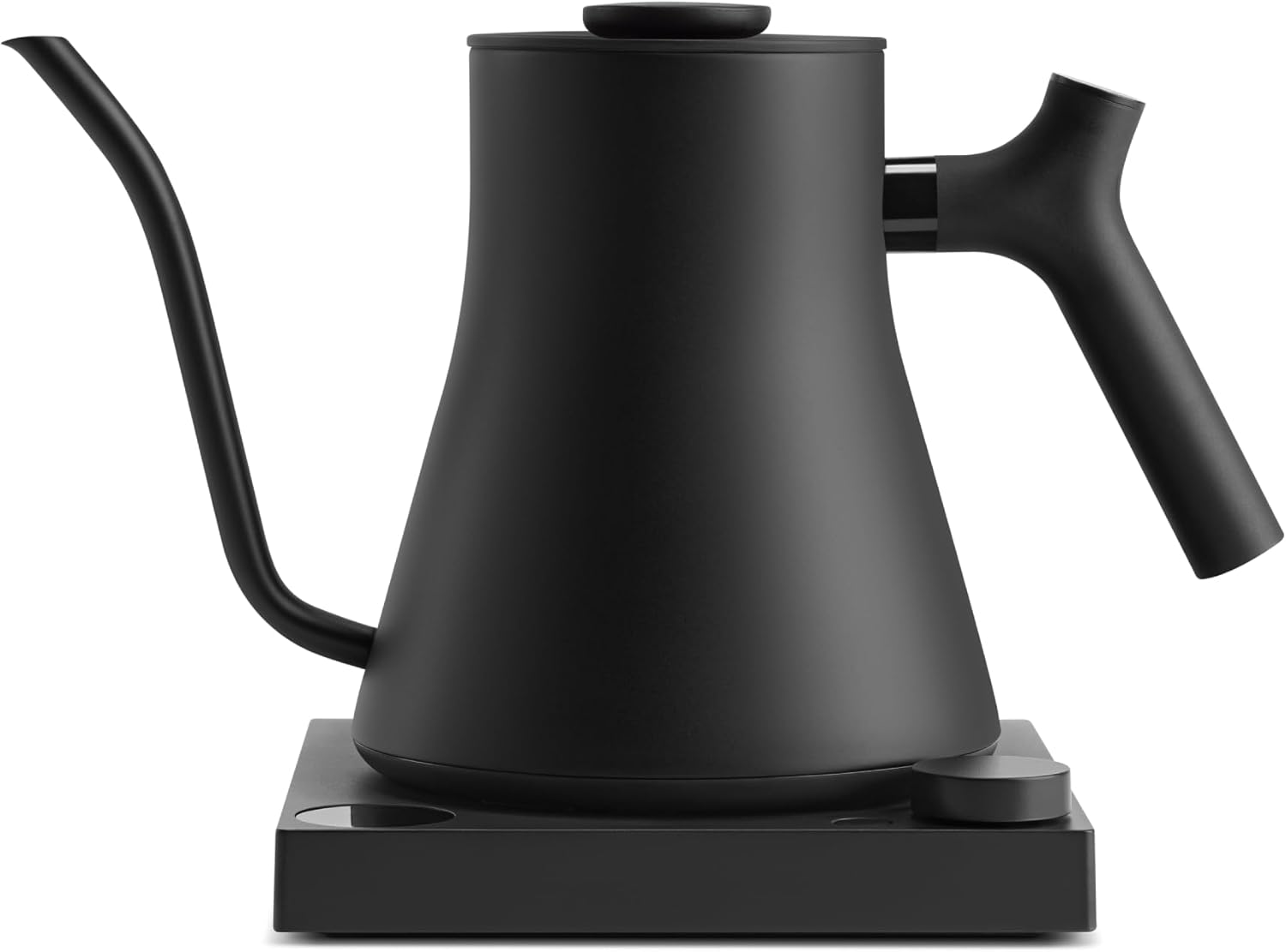
Precision-temperature gooseneck kettle with 1°C variable control and a 60-minute hold. The Pro version adds a built-in stopwatch — useful for pour-over timing without reaching for your phone. Weekend filter coffee only, but when I use it the difference is felt immediately. One of those products that seems expensive until you use one.
Pros
- 1°C precision temperature
- 60-minute temperature hold
- Built-in stopwatch (Pro)
- Beautiful gooseneck design
Cons
- Premium price
- Overkill for espresso only
The Scales — Hario V60 Drip Scale
Coffee scales are one of those things that seem unnecessary until you use them and then you can't go back. Knowing your dose (in) and your yield (out) is how you make the same cup repeatedly — or how you diagnose why the cup today was different from yesterday. The Hario V60 Drip Scale has a built-in timer, a 2kg maximum weight, and reads to 0.1g. It does exactly what a coffee scale needs to do, nothing more.
I use it every morning to weigh my espresso dose (18g in) and monitor my yield. If I'm not in the mood to track, I don't — the muscle memory is there now. But on days I care about the shot, the scale tells me something useful.
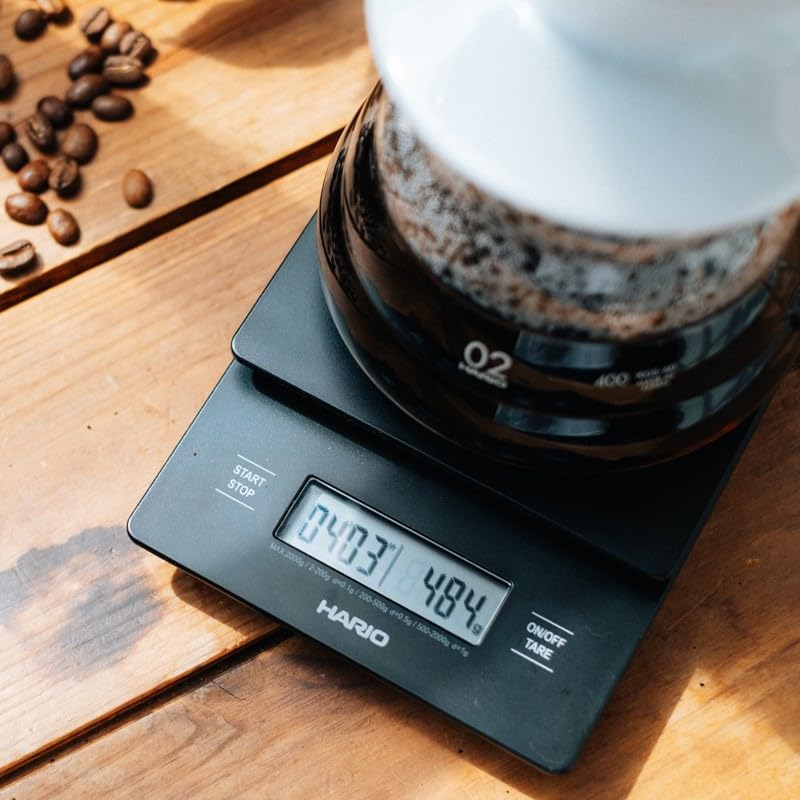
Simple, accurate coffee scale with a built-in timer. 0.1g resolution, 2kg max, auto power-off. Does exactly what a coffee scale needs to do — nothing more. I've used more expensive options and can't justify the extra cost for home use. Eighteen grams in, 36–38 grams out — this scale makes consistency repeatable.
Pros
- Built-in timer
- 0.1g resolution
- Designed for coffee use
- Simple, no-fuss interface
Cons
- Auto power-off can be too quick
- Not waterproof
The Beans — Rotating, but Always Freshly Roasted
I don't use a single subscription — I rotate between a few roasters based on what I'm in the mood for. The constant is freshness: beans roasted within the last two or three weeks make a measurable difference to espresso. Older beans degas faster and produce flat, lifeless shots.
Current rotation: Pact Coffee for their rotating single-origins (I like knowing what I'm drinking and where it came from), Batch Coffee when I want something more approachable, and occasionally Volcano Coffee Works for their espresso-specific blends. None of these are on Amazon, which is fine — I'd rather buy direct and know the roast date is on the bag.
The one thing I'd say about beans: stop buying supermarket coffee for your espresso machine. It doesn't matter how good the machine or the grinder is — stale beans produce stale espresso. Freshly roasted coffee from any decent UK roaster is a bigger upgrade than any equipment change you can make.
What the Counter Actually Looks Like
Daily Espresso Setup
Sage Bambino Plus + 1Zpresso J-Ultra + Hario scale. 18g in, targeting 36–38g out, 27–30 seconds. Flat white to start, americano later in the morning.
Weekend Filter Setup
Hario V60 (02 size) + Fellow Stagg EKG kettle + J-Ultra at V60 setting. 15g coffee, 250g water at 93°C, 3-minute total brew time.
Beans
Rotating between Pact Coffee, Batch, and Volcano Coffee Works. Always freshly roasted — within 2–3 weeks of roast date. Never supermarket coffee.
What's Not on the Counter
Tamper mat (in drawer). Milk jug (Motta, 350ml). WDT distribution tool. None of these need counter space but they all get daily use.
The Small Things That Actually Matter
A few items that don't warrant full reviews but do earn their place:
- Motta milk jug (350ml): A proper stainless steel steaming jug makes a real difference to microfoam quality. The shape matters. Available on Amazon UK for about £12 — buy this before you buy anything else for your flat white game.
- WDT (Weiss Distribution Technique) tool: A needle tool for distributing grounds evenly in the portafilter before tamping. Cheap (under £15), available on Amazon, genuinely improves shot consistency. Ridiculous how much difference a few passes of a needle tool makes.
- Decent tamper: The pressurised tamper that comes with most machines is fine, but a flat-base tamper at the correct diameter makes tamping more consistent. The 58mm base for the Bambino Plus is about £20–30 on Amazon. Get the right diameter — check your portafilter.
- Puck screen: A small metal screen that sits on top of the puck before the shower screen makes espresso. Cleaner puck, easier cleaning, slightly more even extraction. About £8–12 on Amazon. I didn't expect to notice the difference. I noticed the difference.
"The beans matter more than any equipment upgrade you can make. Stop buying supermarket coffee for your espresso machine. It is the single biggest improvement available."
What I'd Buy Sooner
Looking back at the evolution of the counter over the past few years, there are a few things I wish I'd bought earlier and a few things I wasted money on:
Buy sooner: A proper milk jug. A scale with a timer. Freshly roasted coffee. A WDT tool (obscure, cheap, effective). The 1Zpresso J-Ultra rather than the cheaper electric grinder I bought first.
Wouldn't buy again: The De'Longhi combination machine that pre-dated the Bambino (the grinder was the bottleneck and couldn't be upgraded). The bottomless portafilter I bought for the drama of watching the extraction (useful for diagnosing, but not for everyday use). The bean-to-cup machine I bought for the kitchen before realising I was the only person who used it and it took up half the counter.
Coffee is one of those areas where it's very easy to spend a lot of money pursuing diminishing returns. The jump from supermarket beans and a blade grinder to freshly roasted coffee and a decent burr grinder is enormous. The jump from there to the Bambino Plus and the J-Ultra is significant. The jump from there to a Gaggia Classic and a Niche Zero grinder is real but smaller. At some point you're paying for increments rather than step changes, and only you can decide where that line is.