Home espresso is a rabbit hole. You pull one shot that tastes genuinely exceptional and suddenly you're reading about pre-infusion pressure profiles at 11pm on a Tuesday. I understand. The good news is that the entry point is now remarkably low — machines that produce genuinely café-quality espresso start at around £300, and the learning curve is shorter than most people expect.
This list covers four machines across three price brackets. Two for the person who wants excellent espresso without the fanaticism. One for the person who wants to understand and eventually control every variable. And one for the person who wants great espresso with as little effort as possible. All four are on Amazon UK.
| Machine | Type | Best For | Price (approx) | Verdict |
|---|---|---|---|---|
| Sage Bambino Plus | Semi-auto, thermojet | Beginners — best results, easiest | ~£299–£349 | ⭐ Top pick — most people |
| De'Longhi Dedica Arte | Semi-auto, thermoblock | Space-limited / budget | ~£179–£219 | Best compact option |
| Gaggia Classic Evo Pro | Semi-auto, boiler | The enthusiast's machine | ~£449–£499 | Best for learning espresso |
| De'Longhi Magnifica Evo | Bean-to-cup, fully auto | Convenience first | ~£499–£599 | Best fully automatic |
Sage Bambino Plus — The Right Machine for Most People
Sage (sold as Breville in other markets) makes the best beginner-to-intermediate espresso machines available. The Bambino Plus is the smaller sibling to the famous Barista Express, with one key advantage: it doesn't have a built-in grinder. That matters because the built-in grinders on combo machines are always a compromise. Get a separate grinder (the Timemore C2 or a decent electric burr grinder), use the Bambino Plus as the espresso engine, and you'll produce results that embarrass most café machines.
The thermojet heating system is the Bambino's party trick — three-second heat-up time, no waiting. Pressure profiling is automatic (pre-infusion is built in), the steam wand is powerful enough to produce proper microfoam for flat whites and lattes, and the footprint is compact. On Amazon UK, often with a small accessories bundle.
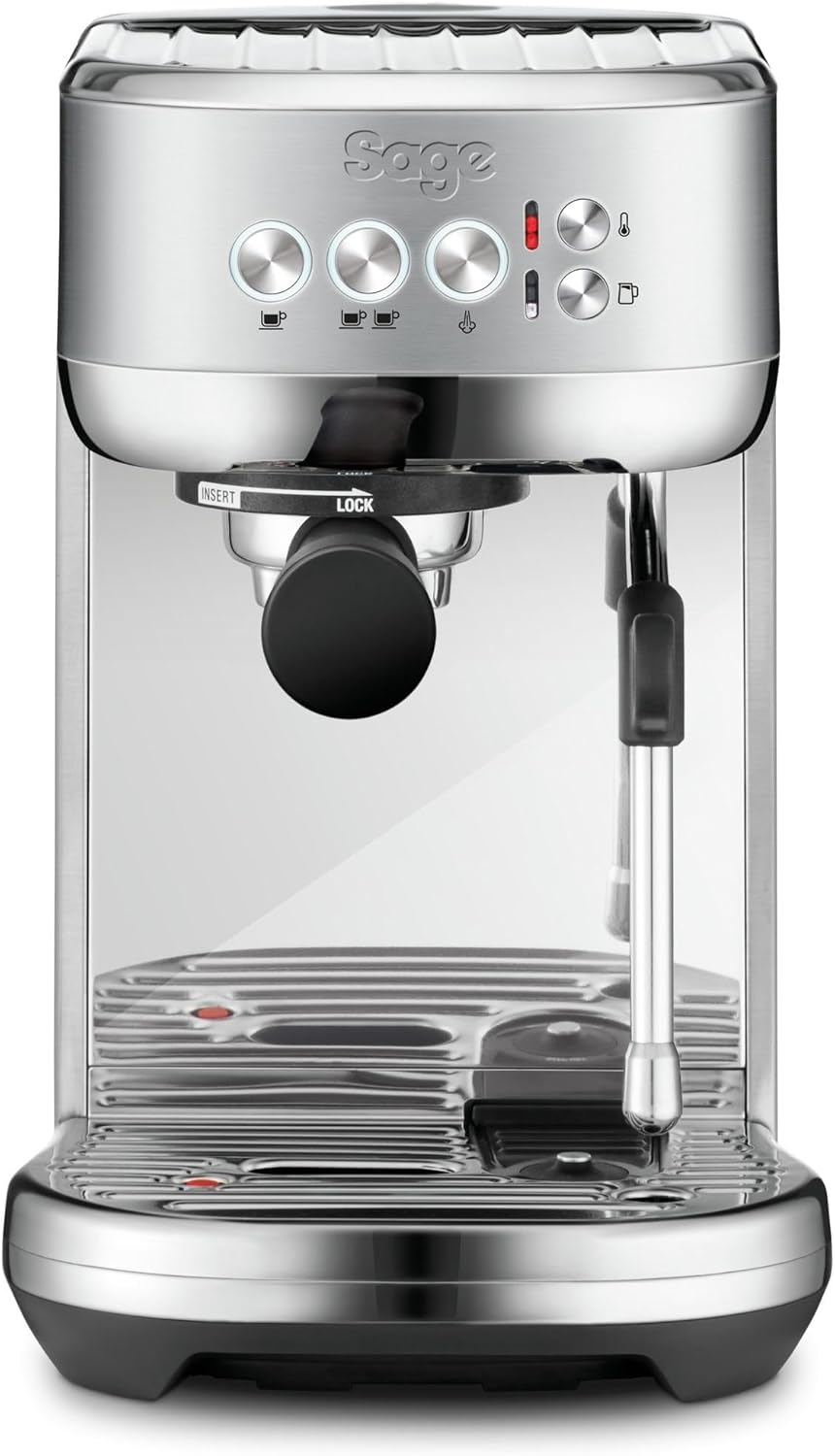
The best entry into home espresso for anyone serious about quality. 3-second thermojet heat-up, built-in pre-infusion, powerful steam wand capable of proper microfoam. Compact footprint. Pairs beautifully with a good separate grinder. Produces genuinely café-quality espresso once dialled in.
Pros
- 3-second heat-up — no waiting
- Built-in pre-infusion
- Powerful steam wand
- Compact — fits small kitchens
- Exceptional results when paired with good grinder
Cons
- Needs a separate grinder
- Limited manual control vs Gaggia
- Proprietary parts — less DIY-friendly
De'Longhi Dedica Arte — When Space is the Constraint
The Dedica Arte (the current Arte version refreshes the older Dedica with improved styling and a slightly better steam wand) is 15cm wide. That's it. If counter space is genuinely limited and you still want proper portafilter espresso rather than pod coffee, the Dedica is the answer. It's not a machine that gives you much control — the temperature and pressure are fixed, the single-wall baskets that come in the box are unforgiving with pre-ground coffee — but fit it with aftermarket double-walled pressurised baskets (available for a few pounds), use decent beans and a good grind, and it produces results that defy its price and size.
The upgraded Arte version has a better manual frother than the older Dedica — it won't produce the textured microfoam of the Bambino's powered steam wand, but it's better than nothing for the occasional latte. Amazon UK stocks the full Arte range.
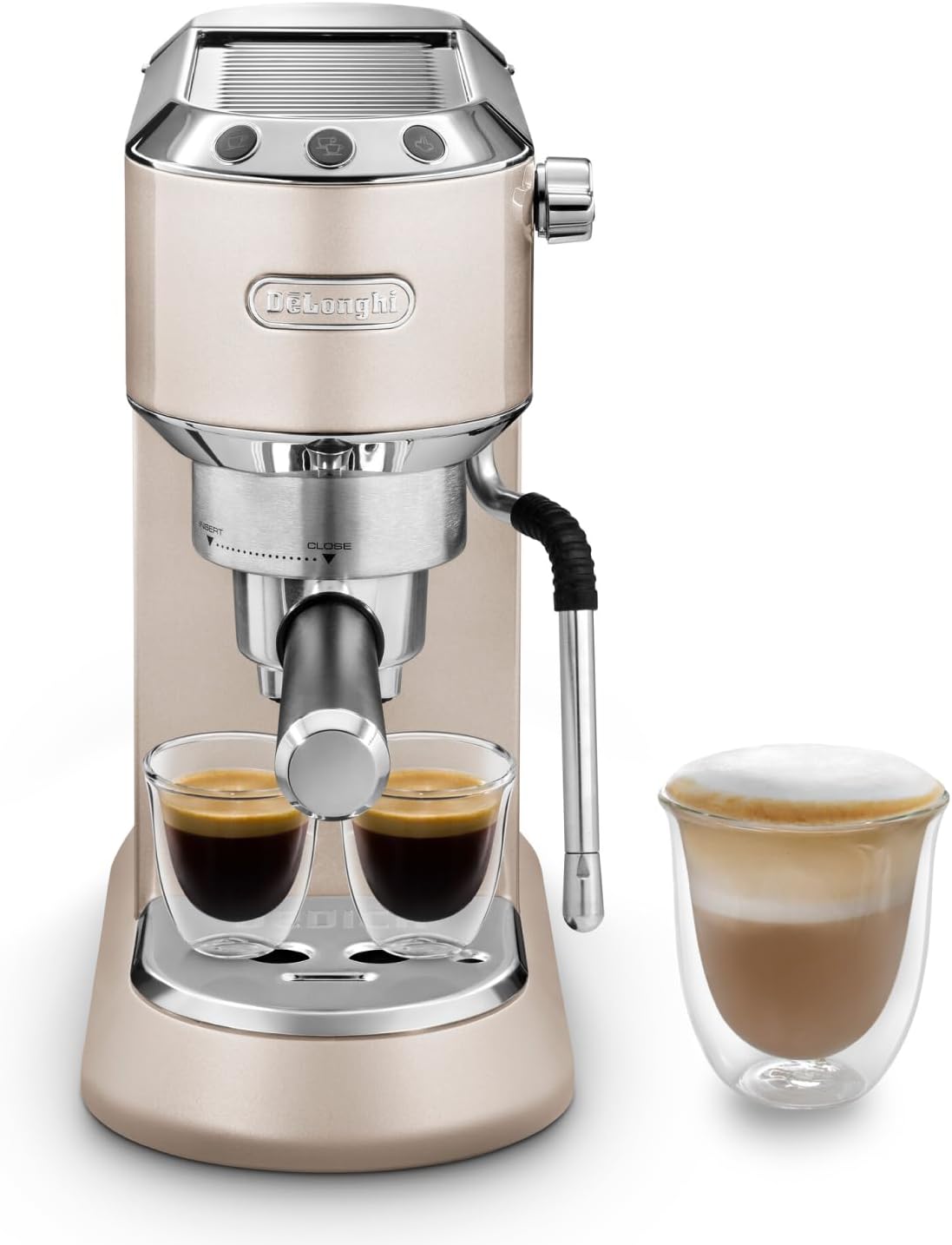
The slimmest quality espresso machine available — 15cm wide, fits where nothing else can. Traditional portafilter, 15-bar pump, manual frother. Use with aftermarket pressurised baskets for best results. The right answer when counter space is the primary constraint. Available in multiple colours.
Pros
- 15cm wide — fits anywhere
- Traditional portafilter experience
- Good value for a semi-auto machine
- Quick heat-up, daily driver
- Multiple colourways
Cons
- Single-wall baskets need replacing
- Limited temperature control
- Frother less capable than Bambino
- Small water tank
"Pull one shot that tastes genuinely exceptional and suddenly you're reading about pre-infusion pressure profiles at 11pm on a Tuesday. The Gaggia Classic is the machine that starts that journey."
Gaggia Classic Evo Pro — For the Enthusiast
The Gaggia Classic has been in production, in various forms, since 1977. The Evo Pro is the current iteration — updated commercially rated group head, improved steam wand, better pressure regulation, and a new OPV (over-pressure valve) factory-set at 9 bar rather than the classic's over-exuberant 12 bar. This matters: 9 bar is the correct extraction pressure for espresso. Earlier Classics required immediate modification to perform properly. The Evo Pro works well from the box, though the community will still tell you to swap the steam tip and add a PID for temperature control. They're right, but it's optional now rather than essential.
What the Gaggia offers that the Sage cannot is repairability, longevity, and an enormous community of experienced users. This machine can be maintained indefinitely — every part is available, and the process of learning the machine teaches you espresso in a way that an automatic machine simply doesn't. It's the enthusiast's path. If you want to understand espresso rather than just consume it, this is the machine. Amazon UK, also stocked by John Lewis.
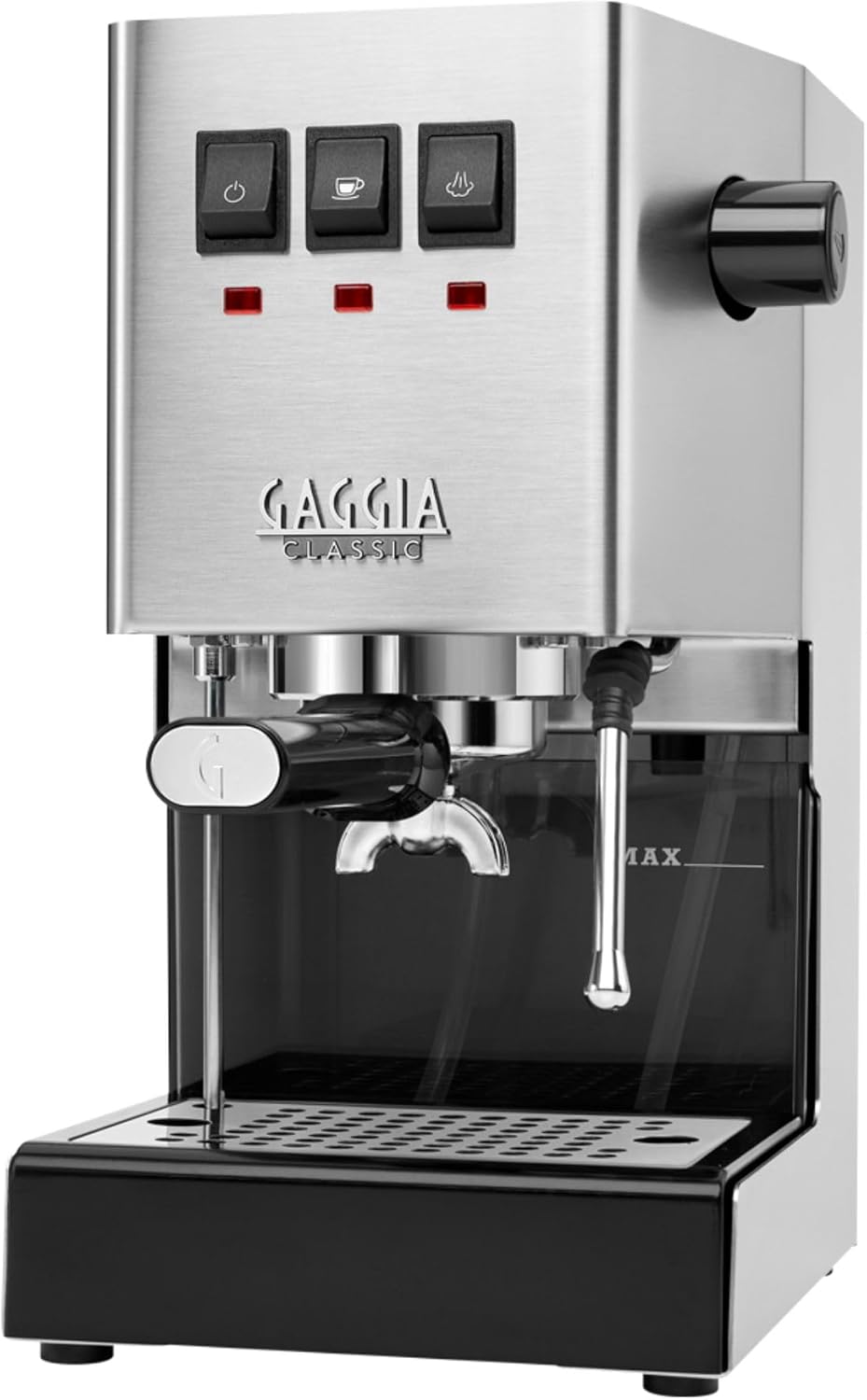
The legendary home espresso machine, now with commercial-rated group head, 9-bar OPV, and improved steam wand. Fully repairable, massive community, enormous longevity. The machine that teaches you espresso properly. Add a PID temperature controller later if you want to go deeper — or don't, and enjoy it as-is.
Pros
- Commercial-rated group head
- 9-bar OPV — factory correct
- Fully repairable — long lifespan
- Huge enthusiast community
- Teaches espresso properly
Cons
- Steeper learning curve
- Single boiler — brew then steam
- Benefits from a PID (extra cost)
- Older aesthetic
De'Longhi Magnifica Evo — When Convenience Wins
Full disclosure: the Magnifica Evo isn't the machine I'd buy. Bean-to-cup machines make trade-offs — the grinder is fixed, the extraction is automatic, the espresso is good but rarely exceptional. What the Magnifica Evo does is eliminate every friction point. Beans in the top, press a button, espresso comes out. For households where multiple people want different drinks at different times with no interest in technique or adjustment, it solves a real problem.
The Evo generation improved the milk system significantly over older Magnifica models — the LatteCrema automatic frothing system produces decent froth for lattes and cappuccinos without any manual involvement. The built-in conical burr grinder covers five grind settings, which is limited but adequate for a machine at this level. If the honest answer to "what do you want from a coffee machine" is "something that works without thinking about it," the Magnifica Evo is a sound choice. Amazon UK, frequently on promotion.
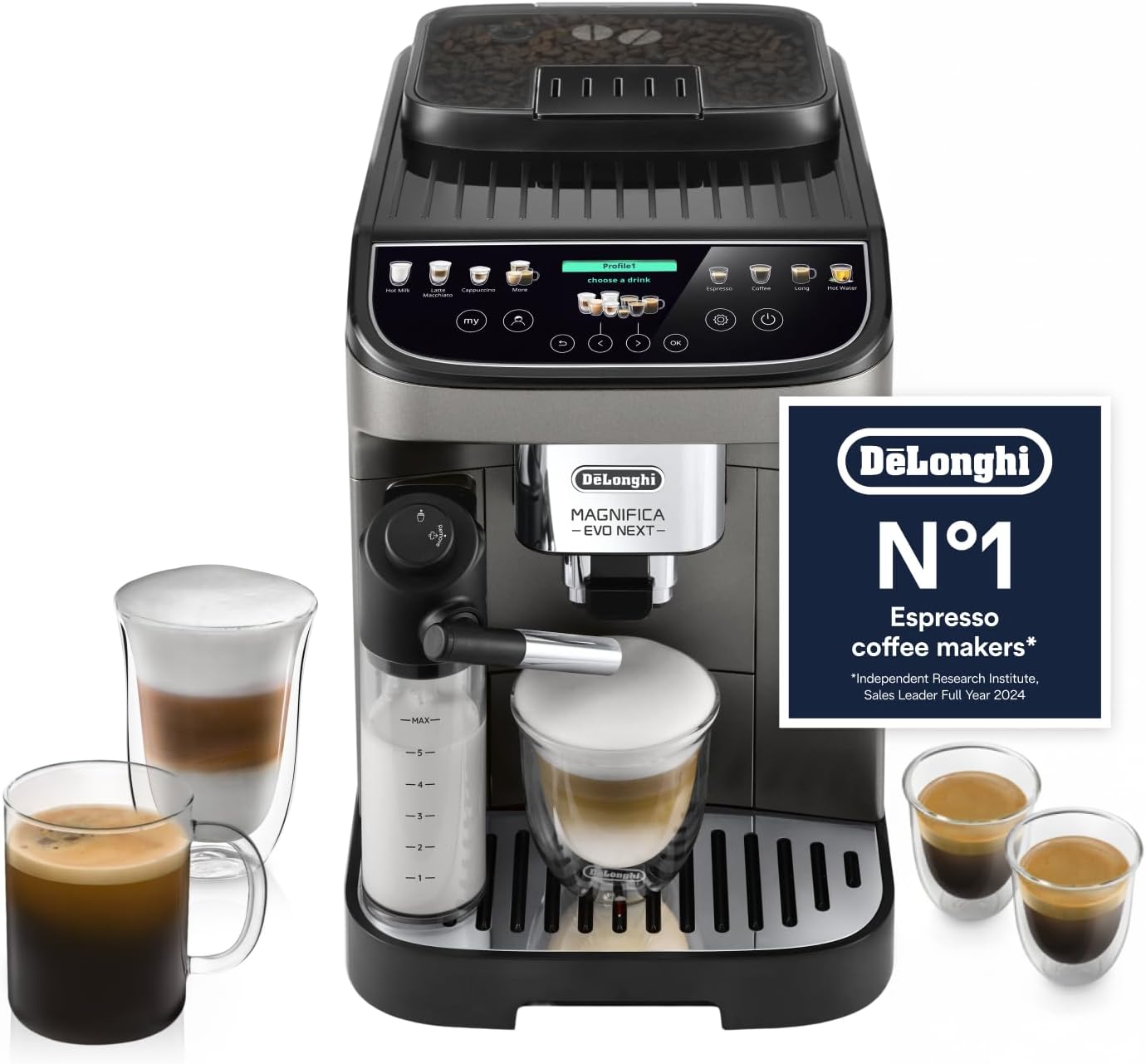
Fully automatic bean-to-cup machine with integrated conical burr grinder and LatteCrema automatic milk system. Press a button, get a latte. Good espresso quality for a fully automatic machine, minimal technique required. The right choice for multi-person households where convenience is the priority.
Pros
- Truly one-touch operation
- Automatic milk frothing
- Built-in burr grinder
- Very user-friendly
- Good espresso for fully-auto category
Cons
- Limited grinder adjustment
- Espresso quality below semi-auto
- Large footprint
- More to clean and maintain
The Grinder Matters as Much as the Machine
This cannot be overstated: the grinder is half the equation. A good machine with a mediocre grinder produces mediocre espresso. A mediocre machine with a good grinder produces surprisingly good espresso. The blade grinder that came in a kitchen bundle will not produce espresso — the particle size distribution is too inconsistent. You need a burr grinder.
For the Sage Bambino Plus or Gaggia Classic, pair with a manual grinder (1Zpresso JX-Pro works brilliantly for espresso) or a dedicated electric burr grinder. The Baratza Encore is a reasonable first electric choice. Step up to the Eureka Mignon or the Niche Zero when you're serious. For the Dedica Arte, a decent electric grinder is more practical given the machine's compact positioning. The Magnifica Evo's built-in grinder is adequate for what the machine produces.
Final Verdict — Match the Machine to Your Mindset
The Sage Bambino Plus is the recommendation for most people — exceptional results, fast warm-up, good steam, manageable price. Pair it with a 1Zpresso JX-Pro or an electric burr grinder and you have a setup that will produce outstanding espresso for years.
The Gaggia Classic Evo Pro is for the person who wants to understand the process. It's more work, more learning, and eventually — once you've learned to use it — more rewarding. It also lasts longer and costs less to repair.
The Dedica Arte solves a space problem. The Magnifica Evo solves a convenience problem. Know which problem you're solving.